
Blog posts tagged "AI/ML"
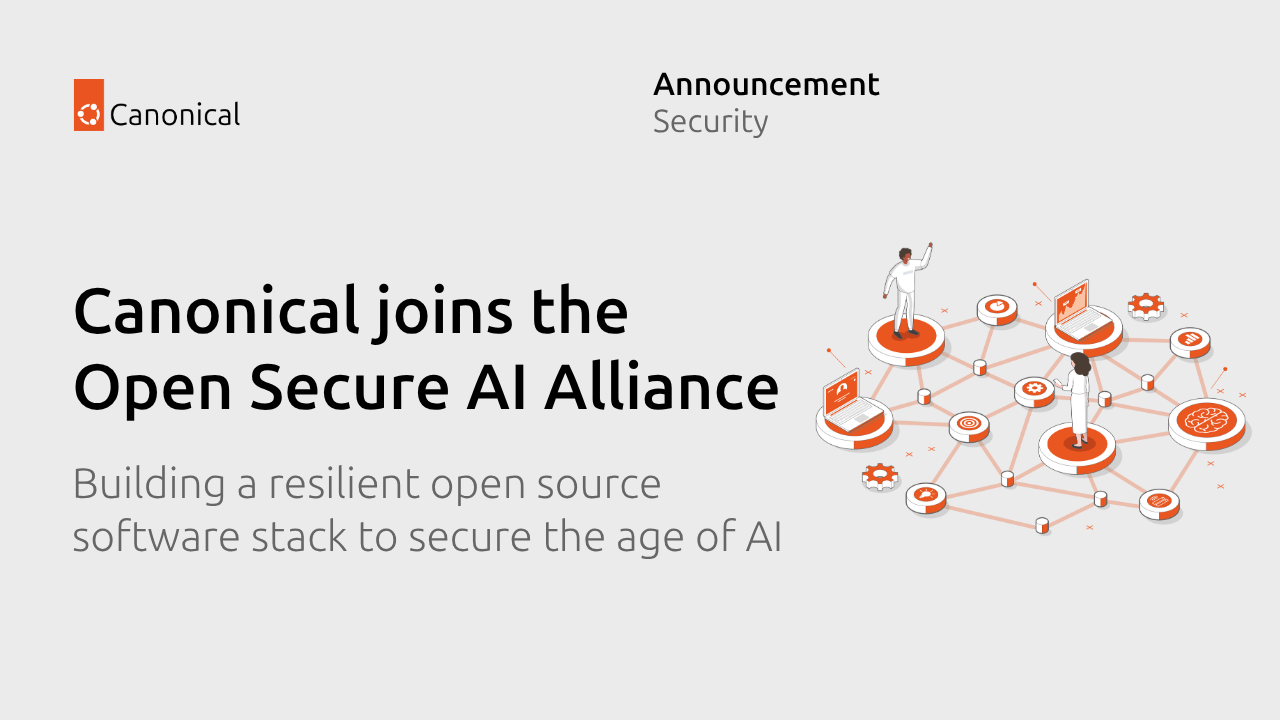
Canonical is now part of the Open Secure AI Alliance, announced by NVIDIA with partners across cloud computing, cybersecurity, enterprise software, open source foundations, and AI research. The alliance aims to develop and share open technologies, techniques, and tools to safeguard software and agents in the age of AI. The bedrock for AI

Tokens per watt (TpW) – the measure of useful AI work produced per watt of energy consumed – is the metric at top of mind for CEOs, heads of AI, and infrastructure teams alike. With the tremendous cost of GPU clusters, extracting as much value as possible from the expense is critical. But in the

By packaging OpenShell as a snap, Canonical is enabling enterprises to confidently run next-generation agentic workflows across local devices, hybrid environments, and private clouds.

Today, NVIDIA introduced the NVIDIA Nemotron™ 3 Nano Omni, a highly-efficient multimodal model designed to understand and reason across video, audio, images, and language. Canonical is enabling immediate access to Nemotrom 3 Nano Omni through inference snaps: pre-packaged AI inference runtimes distributed as snap packages for consistent

At KubeCon Europe in Amsterdam, NVIDIA announced that it will donate the GPU Dynamic Resource Allocation (DRA) Driver to the Cloud Native Computing Foundation (CNCF). This marks an important milestone for the Kubernetes ecosystem and for the future of AI infrastructure. For years, GPUs have been central to modern machine learning and high

Previewing at the event: NVIDIA CUDA support in Ubuntu 26.04 LTS, NVIDIA Vera Rubin NVL72 architecture support in Ubuntu 26.04 LTS, Canonical’s official Ubuntu image for NVIDIA Jetson Thor, upcoming support for NVIDIA DGX Station and NVIDIA DOCA-OFED, and NVIDIA RTX PRO 4500 support. NVIDIA GTC 2026 is here, bringing together the technolo

Official Ubuntu support for the NVIDIA Rubin platform, including the NVIDIA Vera Rubin NVL72 rack-scale systems, announced at CES 2026 CES 2026, Las Vegas. – Canonical, the publisher of Ubuntu, is pleased to announce official support for the NVIDIA Rubin platform and the latest distributions of the new NVIDIA Nemotron 3 open models. As A

Canonical is pleased to announce an expanded collaboration with AMD to package and maintain AMD ROCm™ software directly in Ubuntu. AMD ROCm is an open software ecosystem to enable hardware-accelerated AI/ML and HPC workloads on AMD Instinct™ and AMD Radeon™ GPUs, simplifying the deployment of AI infrastructure with long term support from

Today Canonical, the publisher of Ubuntu, announced support for the NVIDIA CUDA toolkit and the distribution of CUDA within Ubuntu’s repositories. CUDA is a parallel computing platform and programming model that lets developers use NVIDIA GPUs for general-purpose processing. It exposes the GPU’s Single-Instruction Multiple Thread (SIMT

Date: 11 – 13 August 2025 Booth: 353 Book a meeting You know the old saying: what happens in Vegas… transforms your AI journey with trusted open source. On August 11-13, Canonical is back at AI4 2025 to share the secrets of building secure, scalable AI infrastructure to accelerate every stage of your machine learning

Kubeflow is a cloud-native, open source machine learning operations (MLOps) platform designed for developing and deploying ML models on Kubernetes. Kubeflow helps data scientists and machine learning engineers run the entire ML lifecycle within one tool. Charmed Kubeflow is Canonical’s official distribution of Kubeflow. The key benefits o
Artificial Intelligence and Machine Learning (AI/ML) are increasingly driving change in telecommunications. Increased adoption is building organizational confidence in the positive impact that AI can bring, which in turn is leading business leaders to push for AI/ML to expand into new use cases. As such, AI/ML will play a key role in brin

As the number of organizations moving their ML projects to production is growing, the need to build reliable, scalable architecture has become a more pressing concern. According to BCG (Boston Consulting Group), only 6% of organizations are investing in upskilling their workforce in AI skills. For any organization seeking to reach AI matu
2024 was the GenAI year. With new and more performant LLMs and a higher number of projects rolled out to production, adoption of GenAI doubled compared to the previous year (source: Gartner). In the same report, organizations answered that they are using AI in more than one part of their business, with 65% of respondents

New format in Windows Subsystem for Linux makes adoption easier in enterprise environments by enabling image customization and deployments at scale

Canonical is committed to enabling organizations to secure and scale their AI/ML projects in production. This is why we are pleased to announce that we have joined the Open Platform for Enterprise AI (OPEA), a project community at the Linux Foundation focused on enterprise AI using open-source tooling. What is OPEA? OPEA is a project